Sleep disordered breathing & Airway Health
At Prisma Dental | Frisco, Texas
Most people who suffer from sleep apnea don’t even know they have it.
If you experience:
- Daytime sleepiness
- Morning headaches
- Dry mouth upon waking
- Snoring
- Brain fog or difficulty concentrating
- Mood changes or anxiety
- High blood pressure
- Chronic fatigue
Your airway may be the missing piece.
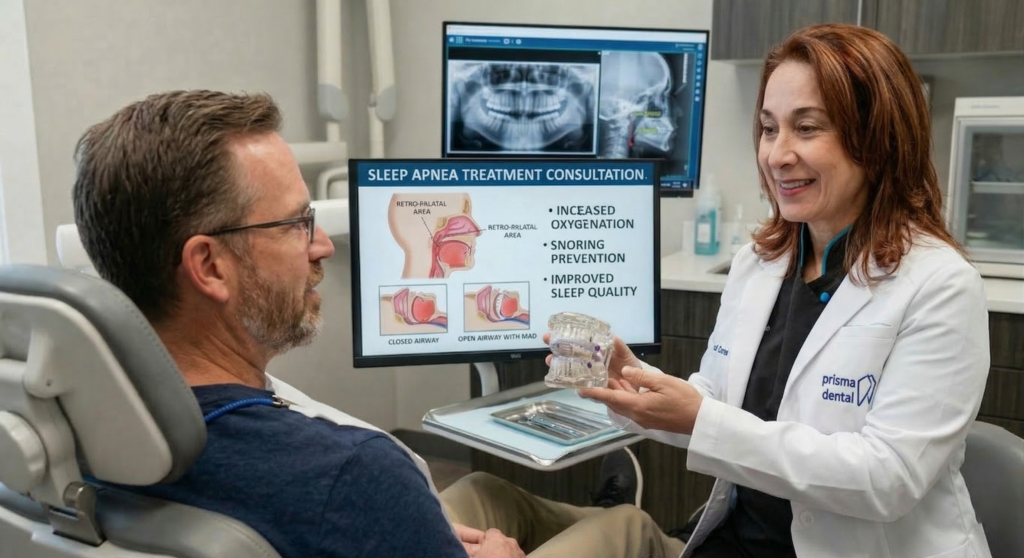
Sleep apnea is not just about snoring. It is a breathing disorder that causes repeated interruptions in oxygen flow during sleep. Over time, these interruptions stress the cardiovascular system, disrupt hormones, impair cognitive function, and increase systemic inflammation.
At Prisma Dental, we approach sleep-disordered breathing differently.
We look beyond the symptom — and evaluate the airway.
Airway-Focused Sleep Solutions for Adults
As a functional and airway-focused dental practice, we assess:
- Jaw position and craniofacial structure
- Tongue posture and function
- Nasal breathing patterns
- Bite and occlusion
- Signs of chronic inflammation
For many patients, custom oral appliance therapy to improve airflow and oxygenation during sleep.
But more importantly — we evaluate why the airway is compromised in the first place.
Because better breathing means:
Better sleep
✔ Better hormone balance
✔ Better cardiovascular health
✔ Better performance — physically and mentally
Children & Sleep-Disordered Breathing
Research over the last two decades has shown a powerful link between childhood sleep issues and airway development.
Mouth breathing, snoring, crowded teeth, bedwetting, ADHD-like symptoms, poor school performance, and behavioral challenges are often not isolated problems — they may be signs of an underdeveloped airway.
Even mild sleep-disordered breathing can affect:
- Cognitive development
- Emotional regulation
- Facial growth
- Academic performance
- Immune function
At Prisma Dental, we evaluate growth patterns early. A narrow upper jaw, recessed chin, or crossbite may indicate restricted airway development.
Why Airway Development Matters
Children are designed to breathe through their noses.
Nasal breathing:
- Filters and humidifies air
- Supports nitric oxide production
- Optimizes oxygen delivery
- Promotes proper facial growth
Chronic mouth breathing, on the other hand, can:
- Alter facial development
- Narrow the palate
- Affect tongue posture
- Increase inflammation of tonsils and adenoids
- Perpetuate airway restriction
When the jaws are guided to develop properly during growth years, the airway can expand naturally — reducing or eliminating many symptoms.
Early intervention can change the trajectory of a child’s health.
Is Your Child Showing Signs of Airway Dysfunction?
Common signs include:
- Snoring
- Nightmares
- Bedwetting
- Mouth breathing
- Dark circles under the eyes
- Crowded or crooked teeth
- Frequent allergies
- Enlarged tonsils/adenoids
- Hyperactivity or difficulty focusing
- Daytime fatigue
Your child may be sleeping…
But not truly resting.
The Prisma Dental Philosophy
We believe dentistry is not just about teeth — it is about breathing, growth, and long-term systemic health.
Our goal is not only to improve smiles,
but to optimize oxygen.
If you or your child struggle with sleep, fatigue, or airway concerns, we invite you to schedule a comprehensive airway evaluation.
Better breathing changes everything.